

When I’m doing an SEO audit for a solar company, the first thing I check isn’t their website. It’s their Google Business Profile.
And nine times out of ten, the pattern is the same, a solid company with good work, 11 reviews, 4.2 stars, and absolutely no recent activity. Meanwhile, a competitor down the road has 87 reviews and owns the local pack.
That gap? It’s rarely about who does better work. It’s almost always about who has a better system for asking.
In the solar industry, Google reviews carry more weight than in most other businesses. Homeowners are making a $10,000+ decision. They research for months. They read reviews twice before calling anyone. The average homeowner researches solar options for 3 to 6 months before making a decision. During that entire research window, your reviews are either building trust or costing you leads.
Why Google Reviews Matter So Much for Solar Companies
Before we get into tactics, let me explain why this isn’t just a “nice to have.”
Reviews Influence Local Pack Rankings
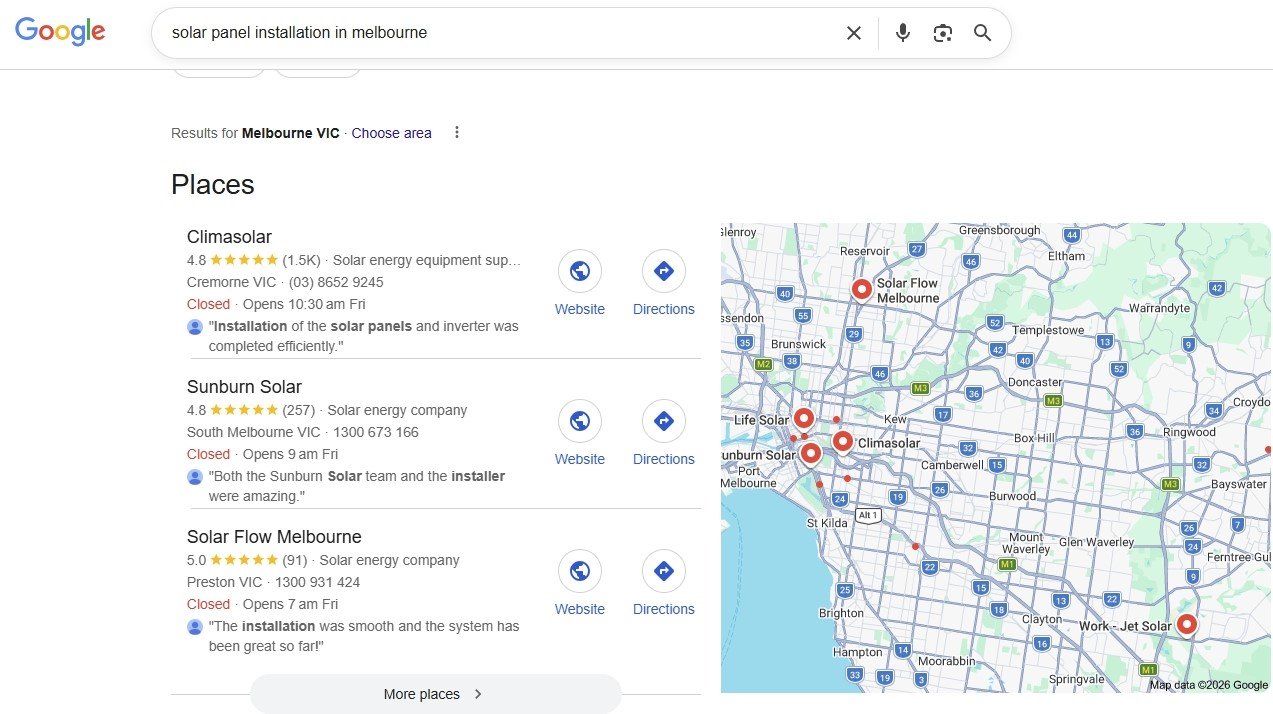
User-generated reviews play a significant role in local SEO, Google often displays review ratings alongside search results. When someone searches “solar company near me” or “solar panel installation in [city],” Google’s local pack shows three businesses. The ones that appear there tend to have more reviews, better ratings, and more recent activity on their profile.
Reviews are one of the major factors in ranking in the local pack. Around 79% of consumers trust online reviews as much as personal recommendations.
If your solar company isn’t in that local pack, you’re invisible to the most high-intent buyers in your area, people who are ready to get quotes right now.
Reviews Convert Browsers into Leads
Ranking is only half the battle. Once someone sees your business, reviews determine whether they click or scroll past you. A solar installation is a high-trust, high-investment decision. Nobody is calling a company with 3 reviews and a 3.8 rating when there’s another option with 60 reviews and a 4.8.
Reviews Give You Keyword-Rich Content for Free
Here’s something most solar business owners don’t realise, your customers’ review text gets indexed by Google. When a happy customer writes “best solar installer in Melbourne, panels installed in one day, team was professional,” that review is essentially free SEO content sitting on your profile. The more detailed reviews you collect, the more keyword signals your profile sends to Google.
This connects directly to why SEO for solar companies is about far more than just your website, your Google Business Profile is its own ranking asset.
The Real Reason Solar Companies Don’t Have Enough Reviews
Let me be direct: your customers aren’t leaving reviews because nobody asked them. Not properly, anyway.
A solar installation is a big deal for a homeowner. The day the panels go live, they’re excited. They’re watching their app, telling their family, feeling good about the decision. That is the exact moment they would happily write you a five-star review, but most solar companies don’t have a process in place to catch that moment.
Instead, what typically happens:
- The installation team finishes and leaves
- A generic follow-up email goes out three weeks later
- The customer has moved on emotionally
- Nobody asks again
- The review never happens
The fix isn’t complicated. It’s just a system.
7 Practical Ways to Increase Positive Google Reviews for Your Solar Business
1. Ask at the Right Moment, Right After Installation
Timing is everything. The highest-converting moment to ask for a review is when the system goes live and the customer sees it working for the first time.
Train your installation team to end every job with something like: “We’re really glad the system is live and looking good. If you’re happy with how things went, it would mean a lot to us if you left us a quick Google review, it helps other homeowners make confident decisions.”
That’s it. Simple, genuine, human. It doesn’t feel like a sales script because it isn’t one.
2. Create a Direct Review Link and Use It Everywhere
One of the biggest review killers is friction. Customers have to Google your business, find your profile, click through to reviews, figure out how to leave one, most people give up halfway through.
Create a short, direct link to your Google review page. You can do this through your Google Business Profile dashboard. Then:
- Put it in your post-installation WhatsApp message
- Include it in your follow-up email
- Add it to the bottom of your invoice
- Print it as a QR code on a thank-you card
The less steps between “I’d like to leave a review” and “review submitted,” the more reviews you’ll collect.
3. Follow Up by WhatsApp, Not Just Email
WhatsApp is where conversations happen. A warm, personal WhatsApp message from the project manager, not an automated blast, the day after installation performs significantly better than an email.
Keep it short:
“Hi [Name], this is [Project Manager] from [Company]. Your solar system is now fully live and generating power. We hope everything went smoothly! If you have a moment, we’d love a Google review, here’s the direct link: [link]. It genuinely helps us reach more homeowners like you.”
Personal. Short. Direct link. That’s all you need.
4. Respond to Every Single Review, Including the Bad Ones
This is where most solar companies leave SEO value on the table. Engaging with reviews and responding professionally can further boost your Google Business Profile’s performance.
When you respond to a positive review, you’re not just being polite, you’re adding more keyword-relevant content to your profile and signaling to Google that your business is active and engaged.
When you respond to a negative review, you’re showing every future customer reading that thread that you take accountability seriously. A well-handled negative review can actually build more trust than a string of unresponded five-stars.
Keep your responses genuine. Don’t copy-paste the same reply to every review, Google notices, and so do customers.
5. Train Your Entire Team, Not Just the Sales Person
Your installers, project managers, and customer service staff all interact with customers at different points. Any one of them can be the person who asks for a review, but only if they know they’re supposed to.
Build review requests into your post-installation checklist. Make it as normal as asking the customer to sign off on the project completion form.
When I worked on local SEO for a mid-size solar company, we found that review volume tripled within 60 days, not from any fancy tool, but simply from briefing the installation team on what to say and when to say it.
6. Make It Easy for Happy Customers to Share on Video
Google now supports photo and video reviews, and these tend to perform extremely well both for conversions and for local SEO signals. After installation, if a customer seems particularly excited, ask if they’d be willing to record a short 30-second video on their phone sharing their experience.
Most will say yes if you ask in person. You can upload it as a case study on your website too, which links back to your broader digital marketing strategy for solar companies.
7. Use Your CRM or Project Management Tool to Automate Follow-Up
If you’re managing a high volume of installations, manual follow-up doesn’t scale. Set up an automated sequence in your CRM or even a simple WhatsApp Business flow:
- Day 0 (installation complete): Verbal ask from the team
- Day 1: WhatsApp message with direct review link
- Day 5: Follow-up email (if no review yet)
- Day 14: Final gentle reminder, include testimonial option as alternative
Don’t send more than three follow-ups. After that, let it go. You never want a customer to feel pressured, that can lead to a negative review.
What NOT to Do (This Can Get You Penalised)
Since we’re talking about staying within Google’s guidelines, let me be clear about what to avoid:
Don’t incentivise reviews. Offering a discount, gift, or any benefit in exchange for a review violates Google’s policies. If Google detects a pattern, your entire review profile can be flagged or removed.
Don’t use review gating. This means filtering customers by asking “Are you happy?” first and only sending the review link to those who say yes. Google explicitly prohibits this.
Don’t buy reviews. Fake reviews are easy to spot, increasingly detectable by Google’s algorithms, and can result in your Google Business Profile being suspended. Your competitors can also report them.
Don’t ask for reviews in bulk from the same location/network. If ten reviews come in from the same IP address in one day, Google will filter or remove them.
The best reviews are organic, spread out over time, and come from real customers with Google accounts that have some activity history.
How Google Reviews Tie Into Your Overall Solar SEO Strategy
Reviews don’t exist in isolation. They’re one piece of a larger local SEO picture that includes your Google Business Profile optimisation, your website’s local landing pages, your NAP (name, address, phone) consistency across directories, and your on-page content.
Your Google Business Profile is often the first thing potential customers see when searching for solar companies. Uploading high-quality photos of your team, installations, and office, and posting regular updates about projects and promotions, all contribute to how Google ranks your profile.
Think of reviews as the social proof layer that sits on top of your technical SEO work. You can rank in the local pack without great reviews, but you won’t convert. You can have great reviews without ranking, and nobody will see them. Both need to work together.
If you want to understand how SEO fits into your solar business growth more broadly, the impact of SEO for solar companies goes much deeper than just reviews, it’s the entire system that brings qualified, organic leads to your door.
FAQ — Google Reviews for Solar Companies
There’s no magic number, but in most mid-size cities, 25–50 genuine reviews with a 4.5+ average rating and recent activity (at least 2–3 reviews per month) is usually enough to compete seriously in the local pack. In more competitive metros, you may need 100+ to consistently hold position.
You can suggest that customers mention their city and the type of system installed (e.g., “5kW rooftop system in {City}”) in a natural, unprompted way, but don’t script their review or tell them exactly what to write. Authenticity is what Google and future customers both value.
Flag the reviews through your Google Business Profile dashboard using the “Report review” option. Document the pattern (multiple reviews from new accounts, similar timing, suspicious language) and submit a formal complaint to Google Support. This process takes time, but Google does investigate and remove fraudulent reviews.
Yes, including relevant location and service keywords naturally in your responses (e.g., “Thank you for choosing us for your rooftop solar installation in {city}”) adds indexable keyword content to your profile and signals active profile management, both of which are positive local ranking signals.
Final Thought: Reviews Are a Business System, Not a One-Time Task
The solar companies I’ve seen dominate their local markets don’t leave reviews to chance. They have a repeatable system, the right ask at the right moment, a frictionless link, a warm follow-up, and genuine responses to everything that comes in.
It’s not glamorous. It’s not a hack. But done consistently, it compounds. A company that collects 4–5 reviews a month will have 50+ by the end of the year, and that’s a profile that converts.
If you want to build a complete local SEO strategy around your Google presence, reviews, profile optimization, local content, and more, let’s talk. Get in touch with Aakhuga Tech and I’ll personally take a look at where your solar business stands.
