
Key Takeaways
- A solar and electrical company in Australia came to us with a website that was live but invisible in search.
- In 6 months, organic clicks went from a handful a day to 24.9K total clicks and 779K impressions, tracked directly in Google Search Console.
- Average CTR sits at 3.2% and average position at 16.1 meaning there’s still real upside left on the table (more on that honestly, below).
- The growth came from fixing technical basics, building out proper local and service pages, and consistent content not from any shortcut or “hack.”
- This is a mid-journey snapshot, not a finish line. I’m sharing the real numbers, including the parts that still need work.
I get asked a lot of the same question by solar business owners across Australia: “Does SEO actually work for a solar company, or is it just for software startups and e-commerce brands?”
Fair question. Solar is a genuinely local, seasonal, and trust-heavy business. People don’t buy a $6,000–$15,000 system from the first ad they see they research, compare quotes, check reviews, and search Google multiple times before picking up the phone. That buying pattern is exactly where SEO earns its keep.
I want to walk you through a real solar company SEO case study an Australian solar and electrical installation business I’ve been working with using the actual Google Search Console data from their account. I’m not naming the client (client confidentiality is non-negotiable for me), but every number below is real, unedited, and pulled straight from their Performance report.
The Starting Point
When this client came to VR Bonkers, the situation was fairly typical for a trades or installation business:
- The website existed, looked decent, but was built without SEO in mind thin service pages, no location-specific content, and slow load times on mobile.
- They were relying almost entirely on referrals, a Google Ads budget, and word of mouth for new jobs.
- Organic search was bringing in next to nothing. Most of their service area searches things like “solar installer [suburb]” or “commercial solar [city]” were being won by directories, comparison sites, and better-optimized competitors.
- There was no consistent content strategy, and their Google Business Profile was only partially filled out.
This matters because it sets the baseline. A lot of “case studies” you’ll read online conveniently skip the boring starting point. I’d rather you see it, because it’s the same starting point most solar and trade businesses are in right now.
The Strategy: What We Actually Did
I’m going to keep this section practical rather than theoretical, because “we did SEO” tells you nothing useful.
1. Technical foundation first Before writing a single word of content, we fixed the things Google was silently penalising: page speed on mobile, duplicate title tags across service pages, missing schema markup for local business and services, and a broken internal linking structure. Google has been consistent for years that Core Web Vitals and crawlability issues cap how well even great content can perform no amount of writing fixes a site Google can’t crawl or trust.
2. Location and service page architecture Solar is a local-intent business. Instead of one generic “Solar Panel Installation” page, we built dedicated pages for the specific service areas and service types the business actually operates in residential solar, commercial solar, battery storage, and solar maintenance each targeting the real language customers search, not internal jargon.
3. Content built around actual buyer questions Every blog and guide we published answered a question a real customer would type into Google before calling things like STC rebate eligibility, system sizing for different roof types, and what to check before hiring an installer. When I worked on a client in the trades and home services space before this one, I saw the same pattern: informational content that answers a pre-purchase question consistently outperforms generic “why choose us” pages for both traffic and lead quality.
4. Google Business Profile and local signals We fully optimised their Google Business Profile categories, service areas, Q&A, regular posts and worked on a steady, honest review-generation process (never incentivised or fake reviews, which violate Google’s guidelines and can get a profile suspended).
5. Consistency over intensity No single tactic here is exotic. What actually moved the needle was doing the unglamorous things page speed, structure, content, local signals consistently for six months instead of in a single burst and then stopping.
The Results: What the Data Actually Shows
Here’s the Google Search Console Performance report, six months of data, Web search only:
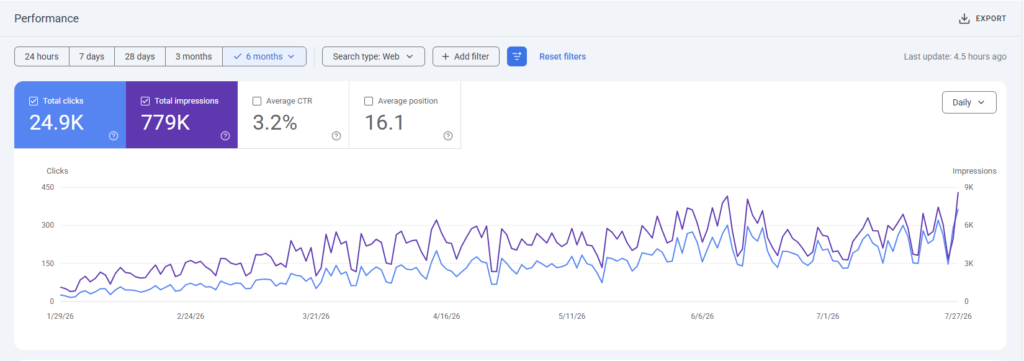
| Metric | Result (6-month period) |
|---|---|
| Total clicks | 24.9K |
| Total impressions | 779K |
| Average CTR | 3.2% |
| Average position | 16.1 |
| Date range | 29 Jan 2026 – 27 Jul 2026 |
Looking at the daily trend line, two things stand out clearly:
- Impressions grew steadily and consistently across the six months the site is now showing up for a far wider set of relevant searches than it was in January.
- Clicks followed the same upward curve, with the expected day-to-day volatility you always see in daily GSC data (weekday vs. weekend search behaviour, seasonal demand shifts around rebate news, etc.).
I want to be upfront about what this data does not say. An average position of 16.1 means most of these impressions are still coming from page 2 of Google, not page 1.
That’s genuinely good progress from a near-zero starting point, but it also tells me exactly where the next phase of work needs to focus: pushing the highest-intent pages (like specific suburb and commercial solar pages) from page 2 into the top 5 results, where CTR jumps significantly. A 3.2% average CTR at position 16 is actually a reasonably healthy number it usually climbs on its own as position improves, since CTR and ranking position are directly correlated in almost every industry benchmark study I’ve seen.
What This Means If You Run a Solar Business
A few honest lessons from this specific case, not generic advice:
- Impressions come before clicks, and clicks come before rank-one positions. If your SEO isn’t working yet, check impressions in GSC first. Rising impressions with flat clicks usually means your pages are being found but not chosen a title tag, meta description, or trust-signal problem, not a keyword problem.
- Local intent beats generic content. The pages that pulled the most weight for this client weren’t blog posts they were well-built, specific service-area pages.
- Six months is realistic, not fast. If anyone promises first-page rankings for a solar company inside 4–6 weeks, that’s a red flag. Google’s own guidance on core updates is explicit that rankings reflect an ongoing recalibration of quality signals, not a one-time fix.
- Rebate and policy content needs to stay current. Solar-related search demand shifts around STC rebate changes and state incentive announcements, so content referencing rebates needs a review cadence, not a “set and forget” approach.
What SEO Can’t Do (Being Honest)
I’d be doing you a disservice if I didn’t say this plainly: SEO didn’t hand this business leads on day one, and it won’t guarantee a fixed number of jobs per month for anyone. What it did was compound steadily reducing reliance on paid ads and referrals by building an asset (organic visibility) that keeps working without a daily spend.
If a business needs revenue in the next two weeks, SEO is not that lever; paid search or direct outreach is. SEO is what you build so that, six and twelve months from now, you’re not still paying for every single lead.
FAQ
Based on this case and others I’ve run, expect early impression growth within 8–12 weeks and meaningful click growth by month 4–6, assuming technical issues are fixed early and content is published consistently rather than in one burst.
They serve different purposes. Ads bring fast, expensive leads; SEO builds a compounding asset that lowers cost-per-lead over time. Most solar businesses I work with run both, shifting budget toward SEO as organic traffic matures.
This usually points to a title tag, meta description, or ranking position problem rather than a content problem. If you’re ranking on page 2 or lower, impressions rise before clicks do improving position is the fix, not rewriting content from scratch.
Yes. Search demand and specific query patterns shift whenever STC rebate values or state programs change, so rebate-related pages need periodic updates to stay accurate and keep ranking outdated rebate figures also hurt trust signals with readers.
Yes, particularly for local and suburb-level searches, where a well-optimised Google Business Profile and dedicated local service pages often outperform a national brand’s generic, non-local pages.
Where This Goes Next
This case study isn’t a finished story it’s a mid-journey report from real data. The next phase for this client is straightforward: convert page-2 rankings into page-1 rankings for the highest-intent service and location pages, since that’s where the next real jump in clicks will come from.
If you run a solar or electrical services business in Australia and your website looks a lot like this client’s did in January live, but invisible I’d be glad to take a look and tell you honestly what I see. Book a call with VR Bonkers and I’ll walk you through it, no fixed promises, just a real read on where you stand.
